The Processing code above is based on the logic implemented in this code I posted before. I just added some random attractors, timing for agents continous initialization and a function to render the field properly. What you get with this code is (a sort of) simulation of percolation. What's interesting I guess is that you can watch the landscape continously changing over time.
The code is written for Processing 2.0 and You will need Toxiclibs and ControlP5.
N : turn on/off agent preview
T : turn on/off agent tail preview
D : turn on/off landscape preview
You can have a look at the code on my Git.
Below some screen captures of the code running:
Saturday, November 28, 2015
Thursday, November 19, 2015
GitHub Repo
As I anticipated in my last post, in order to enhance better sharing and collaboration, I just opened a GitHub account where I uploaded the already shared sketches and all the codes and ongoing experiments yet to come. You can have a look here:
For any of you not familiar with source control and GitHub or simply interested in beginning to use it properly, I strongly suggest this tutorial . and the LearnGit course on codeAcademy.
Monday, November 9, 2015
Field pathfinding
At the time this piece of code was written, I was investigating possible alternatives for pathfinding algorithms. This code came from an idea grown in my mind after working a bit with the fibrous system02 code I posted before. Fibrous system is based on proximity calculation: each agents checks distance to all other agents tail points. This is obviously computationally expensive especially when playing with big populations. The Fibrous system code was then optimized a bit introducing tree data structure, simply using Toxiclibs pointOcTree class, although you can notice improvements in the framerate only while playing with big populations. You can have a look at the code on openProcessing.
At that time I was one of the backers of (the always great) Daniel Shiffman's "nature of code" project on Kickstarter and got fascinated by the chapters about Fields and Agents. The flowField class in the sketch linked below is a modification of the field class from Shiffman's book. I just added some functions for visualization and some agents behaviors. Each agent in the sketch reads data ( direction vectors) from the correspondent field's cell and overrides the previous cell with its current direction. The field becomes a substrate for agents communication (for a sort of pathfinding) and proximity calculation is completely avoided. You can try to run the sketch with 1 Million agents if you want, you will kill the framerate, but the sketch will run (consider that the rendering functions are completely unoptimized, just using VBO the code would run much faster).
You can download the code here.
This the code I used to record this (crappy) video.
After running the sketch and let the system self organize a bit, you can press "c" to destabilize the field..the effects you will get are quite mesmerizing in my personal opinion and resemble a bit some natural behavior like slime mold diffusion .
I'm planning to upload these codes on Github too and I will start to do so from next week post on.
I have been thinking that maybe it would be generally more useful to make this publishing initiative more participatory, instead of being just me posting stuff...so:
If you have any question, critique or suggestion please drop a comment!
If you like the code and you would like to extend it in any way, we could work on it and post it again, so please drop a comment!
If you have any idea on how to use this code for a project and want to collaborate, please drop a comment!
So well yes...drop a comment!:)
below some images of the sketch running:
Saturday, October 31, 2015
Fibrous system 02
Based on the same logic shown in Fibrous system code/post I published time ago. This is the code I used to record this video.
You can download the Processing sketch here.
Wednesday, February 5, 2014
The Red Queen Hypothesis : Chemotaxic stigmergic systems and Embodied Embedded Cognition-based strategies in architectural design
A lot of time has passed by, more then
a year, but I finally decided to put on-line something about the Red
Queen Hypothesis research thesis ( life kept getting in the way).
of stigmergic systems, swarm intelligence and Embodied Embedded Cognition.
The project is developed with the aim of answering the increasing redevelopment request of abandoned post-WW2 buildings in northern Italy, proposing an alternative approach to requalification through processes of intrusion, adaptation and growth, focusing on the relationships between different systems (host/parasite) and innovative fabrication techniques.
Parasiting is a phenomenon where a system exploits resources from another system to thrive and replicate. The original system is not destroyed, however, it becomes an extension of the parasiting system. In order to revitalize an abandoned factory that has become an urban landmark for the community, a parasiting strategy has been implemented through agent based systems.
Agents’ cognitive capacities to perceive the environment, that is the driving factor for adaptation through indirect coordination, have been exploited to investigate emergent and adaptive morphological configuration of semi-rigid bodies, related to existing structures and systems.
Starting from the theoretical premises found in Jeff Jones' paper “Characteristics of Pattern Formation and Evolution in Approximations of Physarum Transport Networks”, the classical multi-agent system model has been extended with chemotaxic stigmergy (the capacity of perceiving and react to chemical gradients of concentration), which has been used as cognitive substrate for a continuous feedback loop with the environment (modeled as a discreet 3-dimensioal non-isotropic voxel field with tensor data in each voxel) and for indirect coordination between agents.
Space negotiation, emergent pattern formation and performative skills have been explored through simulations of multiple populations of agents, competing for resources.
Chemotaxic approach potential has been explored on a multiplicity of scales through a series of digital simulations ranging from volume morphogenesis to surface discretization.
stigmergic grammar from Paolo Alborghetti on Vimeo.
This simulation shows 2 populations of 2500 agents fighting for space negotiation in 2D environment, but “smelling” 3d pheromone field values. Each agent smells pheromone deposition from its population mates, but eat pheromone from the other one. Pheromone field act as communicative substrate for agents relationships ( no proximity calculations here).The bi-populate system grows on z axis, casting material and non-weaving trails networks during the movement.
Fabric intrusion from Paolo Alborghetti on Vimeo.
This simulation shows further application of the stigmergic grammar applied to en existing abandoned building. Given some initial constraints ,a series of simulations have been performed ( isosurfacing the density field), producing a taxonomy of solutions , a catalogue of possible spatial configurations, between which choose the one that best fit space continuity and permeability criterias.
Softbody adaptation + EEC from Paolo Alborghetti on Vimeo.
At a larger scale Embodied Embedded Cognition (emergence of conscious and intelligent behaviour from the interaction of brain, body and world) has been experienced introducing topological shapes for the exploration of adaptive morphological capacities, through soft-body modules (via Verlet integration), instantiating agents over discrete spring-based mesh lattices. Soft-body morphologies are influenced (through gradients of spring stiffness modification) by continuous agent pheromone perception.
The final mesh configuration has been chosen after a long series of simulation on wide range of topologies with different genus. What 's been evident was that closed non-manifold meshes , was the best set up and led to more interesting spatial outcomes. Agents instanced on vertices are obliged to relate to agents / mesh vertices neighbour , avoiding mesh collapse ( often happening with open manifold meshes).
surface Growth from Paolo Alborghetti on Vimeo.
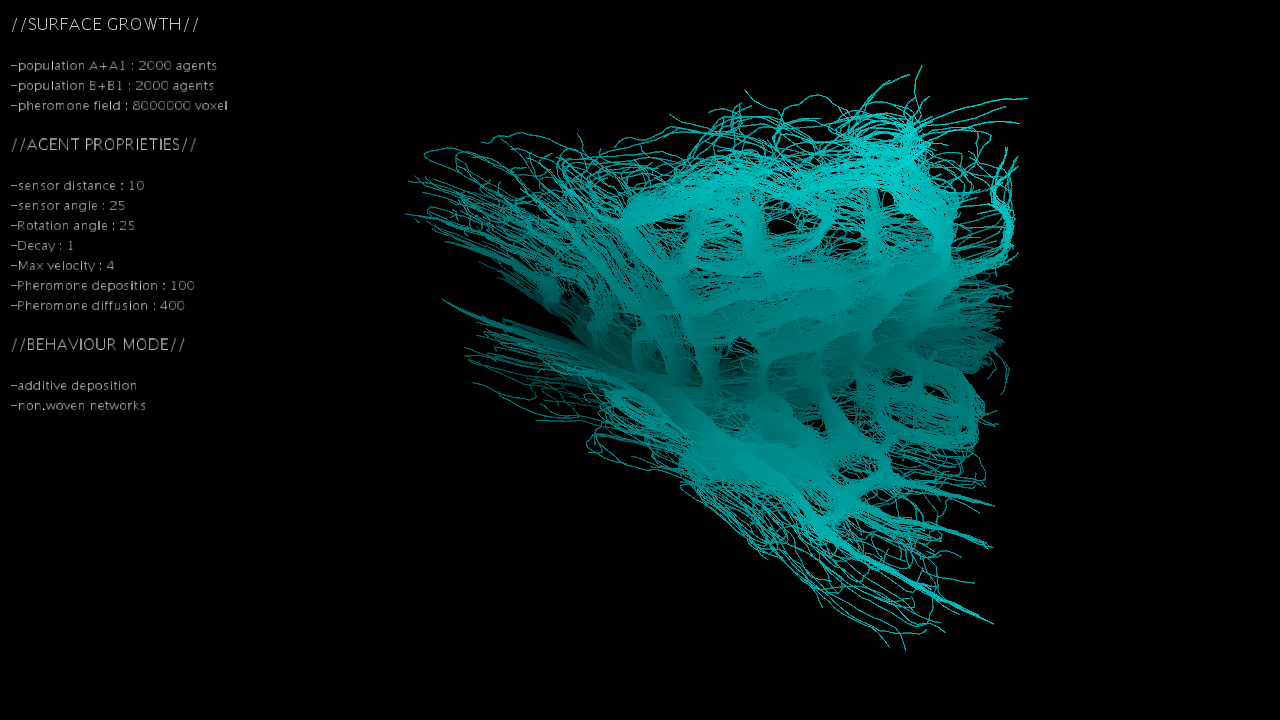
At a finer scale, thanks to the development of a custom strategy for mapping 2D simulation to 3d topological space through undistorted projections, surface's intricated tectonics are the result of multiple population of agents acting influenced by several parameters, including both performative and design-based ones.
Mesh vertices has been charged with different weight layers .Performative ones like radiation analysis (rgb values map ), FEA structural stress analys (rgb values map) . A third layer has been implemented to let the designer influence consciously the process of growth ( grey scale map, hand -painting weight mesh vertices). Proprieties and parameters of the agent cognitive system has been assigned to each weight layer (with the precise intent not to influence directly agents movements, but only their perception of the environment and their relationship with the data stored in the pheromone field).
Sensitive surface growth from Paolo Alborghetti on Vimeo.
Population of agents fight for space negotiation creating fiber-reinforced composites through two different methodologies: the first based on matter accumulation through additive deposition (compliant with contemporary additive manufacturing processes) and the second based on fibrous system through non-woven networks methodologies.
The purpose of the Red Queen Hypothesis is introduce in the computational design process increasing degrees of emergent behavior empowered by cognitive systems that are inevitably influenced by body consciousness (which is also a pivotal argument for AI cognitive protocols) and how this potential can be translated and exploited through contemporary fabrication methods (this last part is the object of future developments).
The work I just presented is just one of the multiple solutions, code logics, ideas, processes I developed and work on during the thesis period.(flickr gallery : https://www.flickr.com/photos/130523864@N03/).
Meanwhile because of the huge amount of time , and work, and life time I dedicated to this I decided to write a “Little list of receipes” for you guys , trying to highlight the mistakes I did, and the little tricks I learned from this experience.
So..here we go:
-always remember : not getting focus on one specific process/code/concept is always bad. Loose time on development of every single idea you come up with will probably take your thesis longer than expected . This is for sure the biggest mistake.
-Even if you are running totally speculative, keep in mind that you're not God or Tesla or what ever you want.
-don't stubborn on totally bottom-up ( I know that the Force is strong in you, but the dark side looks always even stronger) and too complex projects, mainly because of Control issues (which probably would deserve a whole post, given the importance of this topic). “messy computation “ (cit.), for example, could be a good alternative.
-share stuff as much as you can. Share images , videos, codes, processes.The more you give to the community, the more you get back.
-Don't kill your social life spending day and night on code.
-Try to live in a city / community/ collective of culturally active people ( architects, coders, artist, biologist, philosophers...).
-Keep on getting you work reviewed .I'm not talking about official reviews with your thesis advisor ( which by the way are always fundamental),but meet your code/arch /design friends in a pub, with your laptop on the table , sketching logics on pieces of paper.
-never give up.
I want to thank all the people the helped me during this journey:
My thesis advisor Alessio Erioli (http://www.co-de-it.com/) , Jeff Jones (http://uncomp.uwe.ac.uk/jeff/), Niccolo Amaducci , Luca Pedrielli (luca.pedrielli.org) , Alessando Zomparelli(http://dothemutation.wordpress.com/) , Jon mirtschin(http://geometrygym.blogspot.it/), Daniel Shiffman(http://shiffman.net/), Jose Sanchez(http://www.plethora-project.com/), Gwyl Jahn
Some good references
Books:
-G.Lynn, “Animate
form” , Princeton Architectural Press; 1 edition (January 1, 1999).
-M. Hensel,A.
Menges , “Morpho-Ecologies: Towards Heterogeneous Space In
Architecture Design”, AA Publications (February 1, 2007).
-M. Hensel,A.
Menges,M. Weinstock,” Emergent Technologies and Design: Towards a
Biological Paradigm for Architecture”, Routledge (March 4, 2010).
-S. Johnson,
“Emergence: The Connected Lives of Ants, Brains, Cities, and
Software”, Scribner (August 27, 2002).
-J. Reiser,”Atlas
of novel tectonics”,Princeton Architectural Press (2006),New York.
-M. De Landa, “ a
thousand year of non linear hystory”, Swerve edition,New York ,
2000.
-M. De Landa,
“intensive science and virtual philosophy”, Continuum (August 14,
2005).
-M. De Landa,
“Philosophy and Simulation: The Emergence of Synthetic Reason”,
Continuum; 1 edition (March 24, 2011).
-S. Strogatz,
“Sync: How Order Emerges From Chaos In the Universe, Nature, and
Daily Life”, Hyperion; Reprint edition (April 14, 2004).
-F.Otto, “Occupying
and Connecting: Thoughts on Territories and Spheres of Influence with
Particular Reference to Human Settlement”, Berthold Burkhardt, Axel
Menges (January 16, 2009).
-M. Foster Gage,
“Aesthetic Theory: Essential Texts for Architecture and Design”,
W. W. Norton & Company; 1 edition (October 31, 2011).
-P. Schumacher,
“The Autopoiesis of Architecture: A New Framework for
Architecture”, Wiley; 1 edition (January 25, 2011).
-P. Beesley,
“Hylozoic Ground: Liminal Responsive Architecture”, Riverside
Architectural Press; First edition (August 30, 2010).
articles:
-S. KWINTER, “Un
discorso sul metodo”, in Explorations in Architecture Teaching,
design, research, a cura della Swiss Federal Office of
Culture,Birkhäuser , BaselBostonBerlin, 2008 ( traduzione di L. Di
Martino ) e disponibile su:
www.designexplorations.org
-M. HENSEL, A.
MENGES, “Patterns in Performance oriented Design. An Approach
towards Pattern Recognition, Generation and Instrumentalisation” in
AD, Pattern in Architecture, AD Wiley, London, 2008, pp.8893.
-M. DELANDA,
Material Elegance, in Architectural Design (Special Issue: Elegance),
Volume 77, Issue 1, pages 18–23, January/February, AD Wiley,
London, 2007.
-M. FOSTER GAGE,
“Project Mayhem”, in Fulcrum, the AA’s weekly free sheet, issue
18, Giugno 2011 (topic: architecture in the age of dissensus),
-S. KWINTER ,
“Who’s afraid of formalism?”, in “Far from Equilibrium:
Essays on Technology and Design Culture” by Sanford Kwinter and
Cynthia Davidson (Mar 15, 2008).
-Kipnis, Jeffey.
“Toward a New Architecture.” AD: Folding and Pliancy, Academy
Editions, London, 1993.
-S. Allen, “the
field condition” da http://www.crisisfronts.org,2006.
-M. De Landa, “
Material(ism) for Architects : a Conversation with Manuel DeLanda”,
intervista di Corrado Curti, 2010.
-M. De Landa, “
Deleuze and the use of genetic algorithm in Architecture”,2009.
-P. Schumacher,
“Arguing for Elegance”,pubblicato in : Elegance, AD(Architectural
Design), Londra ,2006.
Papers:
-P. Miranda
Carranza, “self-designed and onotgenic evolution”,interactive
institute , Sweden.
-S. von Mammen and
C. Jacob, ”swarm-driven idea models -from insects nests to modern
architecure”, computer science department, Calgary,Canada.
-S. von Mammen and
C. Jacob, “ evolving swarm that build 3D structures”, computer science department, Calgary,Canada.
-S. von Mammen and
C. Jacob, “ the spatiality of swarms - Quantitative analysis of
dynamic interaction networks”, computer science department,
Calgary,Canada.
-V. Ramos ,” self
organized stigmergic document maps: environment as a mechanism for
context learning”,Merida ,2002.
-V. Ramos, “ on
self-regualted swarms,Societal Memory,Speed and dynamics”,Technical
university of Lisbon,Lisbona.
-V.Ramos ,
“artificial ant colonies in digital image habitats - a mass
Behaviour effect study on pattern recognition”, IST geo-system
center, Lisbona .
-V. Ramos , “
computational chemotaxis in ants and bacteria over dynamic
environments.
-J. Jones, “the
emergence and dynamical evolution of complex transport networks from
simple low-level behaviours”, dipartimento di computer
scince,Università di Chester,2008.
-J. Jones,
“characteristics of pattern formation and evolution in
approximations of Physarum Transport Networks”, center for unconventional computing , West England university,Bristol.
-H. Hamann, “
pattern formation as a transient phenomenon in the nonlinear dynamics
of a multi-agent system”,Karlsruhe university (TH),Germany.
-E. ben-Jacob, “
bacterial self-organiztion : co-enhancement of complexification and
adptability in a dynamic environment”, school of Physics and
Astronomy, Tel. Aviv University,Israele.
This work is dedicated to my beloved father, the incredible man that taught me what's really important in life. I miss him every single day.
Tuesday, December 24, 2013
Fibrous Systems
I began to clean up and comment the sketches i have been working on while researching for my final thesis. This first sketch simulates fibrous system, but it can be used to approximate a lot of different behaviours and tasks, like path finding, stigmergy etc..
In the sketch you'll find the main rules i used for this video : https://vimeo.com/45254456 .
You can take a look at the code here : http://www.openprocessing.org/sketch/126240 .
This should be the first of a (hope long) series.
Merry Christmas guys!!
In the sketch you'll find the main rules i used for this video : https://vimeo.com/45254456 .
You can take a look at the code here : http://www.openprocessing.org/sketch/126240 .
This should be the first of a (hope long) series.
Merry Christmas guys!!
Friday, January 25, 2013
Chebbomba!!
Video of a old Arduino project i did a year ago with some friends in one day and one night at the Jam Session organized by the Physical Computing Lab in Milan during 12 and 13 of November 2011.It's a bomb made out of felt with an ID12 RFID reader inside and 3 LEDs that come out of the fuse. Each LED has a different color that matches each of the player's glove. The purpose of the game is to pass the bomb when a LED turns on and the device recognize if the receiver has the same color of the LED by reading a RFID tag embed inside every glove. If the bomb is not "defused" in time, it plays a theme from star wars. Nerds to the bone.
Chebbomba was made by:Stefano Airoldi,Paolo Alborghetti,Davide Caprioli,Alessandro Casmirri,Matteo Loglio,Giulia Pretti...
Lot of fun!!
Chebbomba! from matteo on Vimeo.
Chebbomba was made by:Stefano Airoldi,Paolo Alborghetti,Davide Caprioli,Alessandro Casmirri,Matteo Loglio,Giulia Pretti...
Lot of fun!!
Chebbomba! from matteo on Vimeo.
Sunday, January 13, 2013
[FF]
Flying Foliage is a project ,developed with a friend of mine (Marco Carrara), for INNATURE2 idea-competition. We had to propose a cutting-edge concept for a new model of natural center.The project is about a natural center situated in California (US) in the sequoia park.In this park the users find the oldest living being on earth. Enormous trees and amazing landscapes. The aim of the project is build a relationship with existing trees and give the users a new way of looking at nature.The lightweight-building is mobile. With the help of inflatables baloons, it can slowly fly and reach the top of the trees. In this way users can observe this macro-ecology form a non-human scale and point of view.While doing this the building doesn’t damage the existing sequoias (not anchoring to them). This continuous movement do not produce noise (as machines or planes do) preserving the silent and the atmosphere that the user find in these places. Anchored to the ground with a cable, the building can get back to the terrain after floating in the air. This produce an interesting contradiction: on one side you find heavy and big trees that transfer their weight to the ground, on the other side the building that float in the air,cable-anchored in tension like pure lightness.
The concept has been developed in 3 days only out of work-time, working during lunchtime and after dinner till the force has been with us (as Yoda would probably say).Given the suuuper-short time, i have to say i'm quite happy of the result.
Unfortunately we only arrived between the 12 finalists.Sigh!|
Friday, November 30, 2012
The Red Queen Hypothesis
"Well, in our country," said Alice, still panting a little, "you'd generally get to somewhere else — if you run very fast for a long time, as we've been doing."
"A slow sort of country!" said the Queen. "Now, here, you see, it takes all the running you can do, to keep in the same place. If you want to get somewhere else, you must run at least twice as fast as that!"
Wednesday, November 14, 2012
PROJECT ON PLANE
Another little simple function i've been using in some codes (thanks wolfram mathworld),especially to project agents, running 2D ,on a mesh face.You can use it to project vectors on any planes too,giving at least three points.You will need toxiclibs for this(i know there is a way to do the same thing with toxi rays).
Vec3D projectOnTriangle3D(Vec3D r, Vec3D a,Vec3D b,Vec3D c) {
float aa, bb, cc, dd;
float x1 = a.x;
float y1 = a.y;
float z1 = a.z;
float x2 = b.x;
float y2 = b.y;
float z2 = b.z;
float x3 = c.x;
float y3 = c.y;
float z3 = c.z;
aa = y1 * (z2 - z3) + y2 * (z3 - z1) + y3 * (z1 - z2);
bb = z1 * (x2 - x3) + z2 *(x3 - x1) + z3 *(x1 - x2);
cc = x1 *(y2 - y3) + x2 * (y3 - y1) + x3 *(y1 - y2);
dd = -(x1 *(y2 *z3 - y3 *z2) + x2 *(y3 *z1 - y1 * z3) + x3 * (y1 * z2 - y2 *z1));
float z = (-dd - aa * r.x - bb * r.y)/cc;
Vec3D projVec = new Vec3D(r.x, r.y, z);
return projVec;
}
Saturday, November 10, 2012
TRIPODS INVASION
I have been working on a model of tripod (going on with my studies about agents and embodiment), directly inspired by robotic arms structure.Each tripod is composed by agents and springs.Each arm (like some models of robotic arm) is made up by struts and ties that gives the tripods its ability of self-sustaining. Each node of the arms is composed by agents that have different ability and functions.This combination gives the tripos the capacity of move , seek ,float, jump, stick together and self organize into larger assemblies. The variation of flocking parameters after clustering ,gives control on morphological and structural organization of the assemblies.I have to say that this model is very nice...it reminds me a lot some sci-fi movies about spiderbots invasion!!
TRIPODS INVASION!! from Paolo Alborghetti on Vimeo.
Thursday, October 25, 2012
Initialize vector onto mesh face
Here is a little function i wrote some time ago. If you want to
initialize your agents onto a specific face of your mesh , this is what
you're looking for mate!.You provide,as argument, aWEFace and it returns
a vec3D (toxiclibs library needed).
Vec3D initInTriangle3D(WEFace f) {
Vec3D r = new Vec3D();
float a1 = random(1.0);
float a2 = random(1.0);
Vec3D v0 = f.a.copy();
Vec3D v1 = f.b.copy().sub(v0);
Vec3D v2 = f.c.copy().sub(v0);
r = v1.copy().scaleSelf(a1).addSelf(v2.copy().scaleSelf(a2).scaleSelf(1-a1));
r.addSelf(v0);
Vec3D r1 = new Vec3D(r.x, r.y, r.z);
return r1;
}

Grab the processing file here.
I have other functions and piece of code that i'll be posting (hope weekly).
Friday, October 19, 2012
Thursday, October 11, 2012
Body studies
These are some of the initial studies a i did,about agent and bodies.Trying to escape as far as possible form isosurfacing, i decided to extend my agent class with toxiclibs VerletParticle class.This allowed me to connect different agents with springs.Now..."this is a story of a lonley agent named Bob walking on his way.One day he finally met another bob and said"hey mate,take my hand and we will walk toghether fo evah!(true story!).
SpringAgentsChain from Paolo Alborghetti on Vimeo.
The logical next step was implement that logic on mesh,turning vertices into agents,edges into spring.Changing flocking paramenters you can guide the deformation of the mesh.Interesting morphologies emerge.
SpringMeshAgent from Paolo Alborghetti on Vimeo.
Monday, October 8, 2012
Stigmergy models
Some mounths ago i've been working on some models of stigmergy,just to get confidence with the tools(processing) and the systems i'd have been working with, for my thesis.
The first model is basically based on a common flocking algorithm,but every agent perform flocking towards tail points, and not towards other agents.Here the diffusion of pheromone (like what happen in nature,see ants and termites) is simulated by range of vision of every agents, and pheromone decay by tail length (longer the tail,higer the probability of an agent to follow the others).
I implemented toxi pointoctree (thanks Tommaso Casucci),for optimisation of tail point search (long tails means bigger array of points---->kill framerate) and because i was interested in working with huge population of agents.Here a short video of the model:
stigmergic fibrous systems from Paolo Alborghetti on Vimeo.
The second model was based on the idea of using a vector field.The outcome was really simple and computationally lightweight.It was not stigmergy,but a kind of model of percolation.Here Every agent reads its future location and writes his speed in the field.I have to say that it's funny when you're trying something and you end up with something completely different.Here a short video of the model:
percolation 2 from Paolo Alborghetti on Vimeo.
The third model i've been working with,and was the one i've been working on the most,is based on a semplified version of the model of jeff jones based on chemotaxis (for the simulation of slime molds behavior).You can find more information here: http://uncomp.uwe.ac.uk/jeff/.
This code is based on a pheromone field (field of values).Every cicle each agent deposits pheromone (like little farts...we can call it "farting agent" ) and reads pheromone value correspondent to his future location (smell other agents farts).For more information about the model i suggest to take a look at the link above(nothing about farting in Jones papers obviously!!).
I have to say that this model is amazing!It is really lightweight,you can work with huge population and tuning parameters you can obtain a wide range of patterns.
Here a short video of the model (10000 agents,two different populations fighting for space occupation,each one eating the other one pheromone):
stigmergic networks_2 populations from Paolo Alborghetti on Vimeo.
Friday, July 6, 2012
Subscribe to:
Posts (Atom)